
Haley Lim
Finding a career path in energy efficiency and innovation
Originally from Saint Charles, Illinois, Haley Lim graduated from Loyola University Chicago in 2014 with a bachelor's degree in environmental science. She currently works as a senior emerging technology analyst at GTI Energy, a technology development organization focused on deploying energy solutions that improve lives, economies, and the environment. Lim shared her thoughts about how her Loyola education prepared her to succeed in her career.
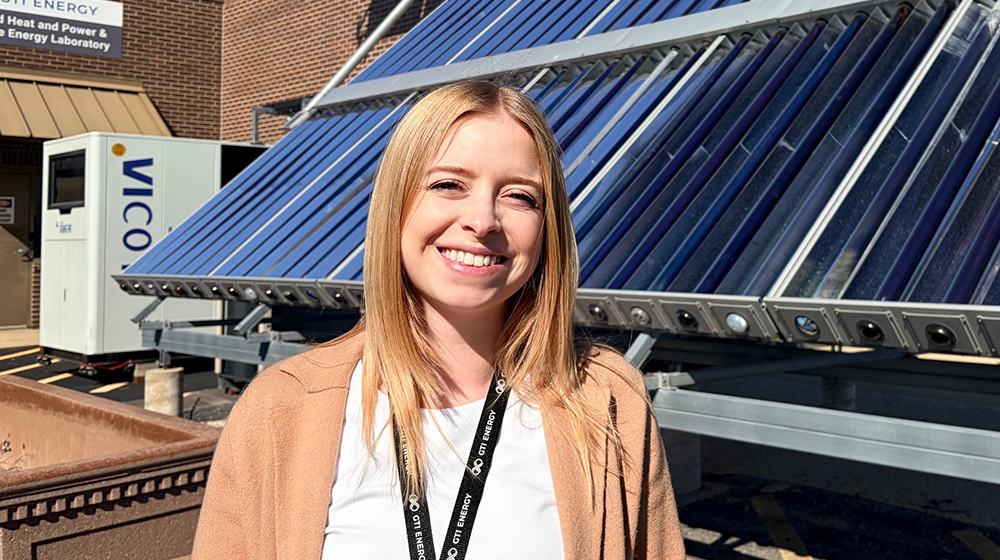
Haley Lim collaborates with technology manufacturers to pilot new cutting-edge heating technologies in her role as a senior emerging technology analyst at GTI Energy.
What led you to choose Loyola and the School of Environmental Sustainability (formerly the Institute of Environmental Sustainability) for your education?
I appreciated Loyola's commitment to making a positive contribution to both the local community and society at large. During my campus tour, it was evident that there are numerous opportunities for engagement and involvement within the institution. I was ready for my world to expand, and I could tell Loyola was the right place to do that.
How has your career developed since graduating from Loyola?
Since graduating, I've worked at four companies in the energy efficiency and energy research industry. Immediately after graduation, my first job sent me through specific training for building analysts to gain expertise in residential energy efficiency. About five years after graduating, a different job allowed me to take a certification course with the Association of Energy Engineers, where I earned the Certified Energy Manager title. Along the way, I have benefited from work-sponsored education opportunities and have been able to develop expertise in the energy efficiency industry.
What type of work do you do in your current job?
I collaborate with technology manufacturers to pilot new cutting-edge heating technologies. Once a new technology is proven in a lab setting, we pilot the technology in a residential home or a commercial building. This stage of development is critical for finding any major issues or opportunities for improvement. We closely monitor all new equipment in the field with sensors to measure overall performance. A successful field pilot can provide a strong case study for launching new energy-efficient technologies into the market.
How did your experience at Loyola influence your career interests or goals?
When I graduated, I felt unsure about which environmental field I wanted to pursue. At Loyola, I completed the sustainable agriculture concentration that was available at that time. However, a mentor at the university suggested that I apply for a role as an energy analyst for a local nonprofit. I ended up sticking with the energy industry and have been successful in my roles even though my education didn't focus on energy.
How did your education in SES prepare you to work in your chosen field?
The environmental science degree was well-rounded in terms of math and science courses. I often use math and critical thinking in my chosen field and have always felt prepared to handle real-world decisions due to the critical thinking I practiced during my education. I also minored in business management through Quinlan and have applied what I learned in information systems and management courses to all my professional roles.
What are some of your highlights from your time at Loyola?
I enjoyed the wide variety of classes I was able to take that contributed to my environmental science degree. I also benefited immensely from activities outside the classroom. As a student, I led the Growers' Guild student club for three years, where we grew edible plants on the Mertz Hall terrace. Another highlight of my experience as a student was running ChainLinks, the student-run bike shop. Through ChainLinks, I got exposure to the local community and interacted with the surrounding Alderperson offices. It was extremely valuable and rewarding to build a business and represent Loyola as an institution that cares about active transportation and a healthy community.
What advice would you give to current or prospective SES students?
My advice would be to get involved in campus activities outside of classes. There are endless ways to get involved, and you'll learn skills that will benefit you as you move into your life as an independent adult. Now is the best time to push yourself outside of your comfort zone.
October 2025
What led you to choose Loyola and the School of Environmental Sustainability (formerly the Institute of Environmental Sustainability) for your education?
I appreciated Loyola's commitment to making a positive contribution to both the local community and society at large. During my campus tour, it was evident that there are numerous opportunities for engagement and involvement within the institution. I was ready for my world to expand, and I could tell Loyola was the right place to do that.
How has your career developed since graduating from Loyola?
Since graduating, I've worked at four companies in the energy efficiency and energy research industry. Immediately after graduation, my first job sent me through specific training for building analysts to gain expertise in residential energy efficiency. About five years after graduating, a different job allowed me to take a certification course with the Association of Energy Engineers, where I earned the Certified Energy Manager title. Along the way, I have benefited from work-sponsored education opportunities and have been able to develop expertise in the energy efficiency industry.
What type of work do you do in your current job?
I collaborate with technology manufacturers to pilot new cutting-edge heating technologies. Once a new technology is proven in a lab setting, we pilot the technology in a residential home or a commercial building. This stage of development is critical for finding any major issues or opportunities for improvement. We closely monitor all new equipment in the field with sensors to measure overall performance. A successful field pilot can provide a strong case study for launching new energy-efficient technologies into the market.
How did your experience at Loyola influence your career interests or goals?
When I graduated, I felt unsure about which environmental field I wanted to pursue. At Loyola, I completed the sustainable agriculture concentration that was available at that time. However, a mentor at the university suggested that I apply for a role as an energy analyst for a local nonprofit. I ended up sticking with the energy industry and have been successful in my roles even though my education didn't focus on energy.
How did your education in SES prepare you to work in your chosen field?
The environmental science degree was well-rounded in terms of math and science courses. I often use math and critical thinking in my chosen field and have always felt prepared to handle real-world decisions due to the critical thinking I practiced during my education. I also minored in business management through Quinlan and have applied what I learned in information systems and management courses to all my professional roles.
What are some of your highlights from your time at Loyola?
I enjoyed the wide variety of classes I was able to take that contributed to my environmental science degree. I also benefited immensely from activities outside the classroom. As a student, I led the Growers' Guild student club for three years, where we grew edible plants on the Mertz Hall terrace. Another highlight of my experience as a student was running ChainLinks, the student-run bike shop. Through ChainLinks, I got exposure to the local community and interacted with the surrounding Alderperson offices. It was extremely valuable and rewarding to build a business and represent Loyola as an institution that cares about active transportation and a healthy community.
What advice would you give to current or prospective SES students?
My advice would be to get involved in campus activities outside of classes. There are endless ways to get involved, and you'll learn skills that will benefit you as you move into your life as an independent adult. Now is the best time to push yourself outside of your comfort zone.
October 2025